- Capabilities
- Getting started
- Architecture center
- Platform updates
Migrate ontological resources to another ontology
Every ontology resource is associated with the ontology in which it is created. You can move resources from one ontology to another after creation using Ontology Manager. Migrating resources can change their permissions, but it does not change permissions on the underlying data or input datasources. Object edits are preserved by default when you migrate object types.
Supported resources and limitations
You can select the following ontological resources for migration:
Value types are associated with a space and are not ontological resources, so you cannot migrate them to another ontology. Migrating an object type or shared property does not migrate its value types. If you want to migrate an object type or a shared property using a value type, you will need to unassign the value type before migration.
You cannot migrate object types from a private ontology to the default ontology unless the object type was originally created in the default ontology. When migrating an object type group, you must also select the object types in the group that you want to migrate .
Before you begin
Save or discard any pending ontology changes, and make sure you have permission to migrate resources to the destination ontology. Review the permissions that will apply to the migrated resources, including those inherited from their destination project.
Identify all relevant connected resources for the migration, such as object types connected by a link type you will migrate from one ontology to another. The migration will fail if the required ontological resources are missing from your selection.
Migrate selected resources
Follow the instructions below to migrate resources from one ontology to another:
-
Open Ontology Manager. Use the ontology selector at the top of the left sidebar to switch to the ontology that owns the resources.
-
Open the ontology selector again and select Migrate ontology entities.
-
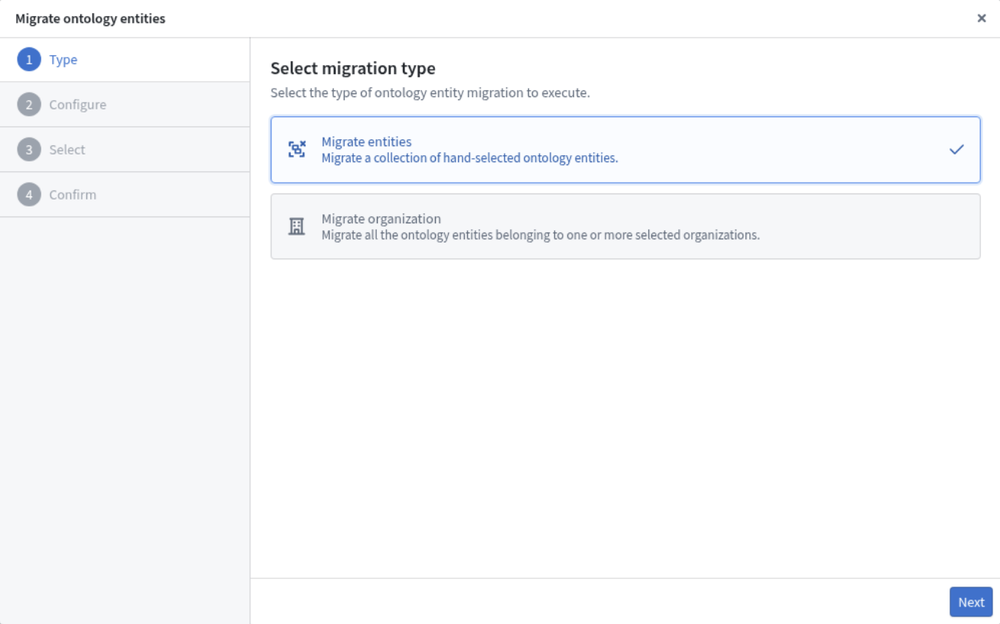
In the Type step, choose Migrate entities to migrate individually selected resources, then select Next.
-
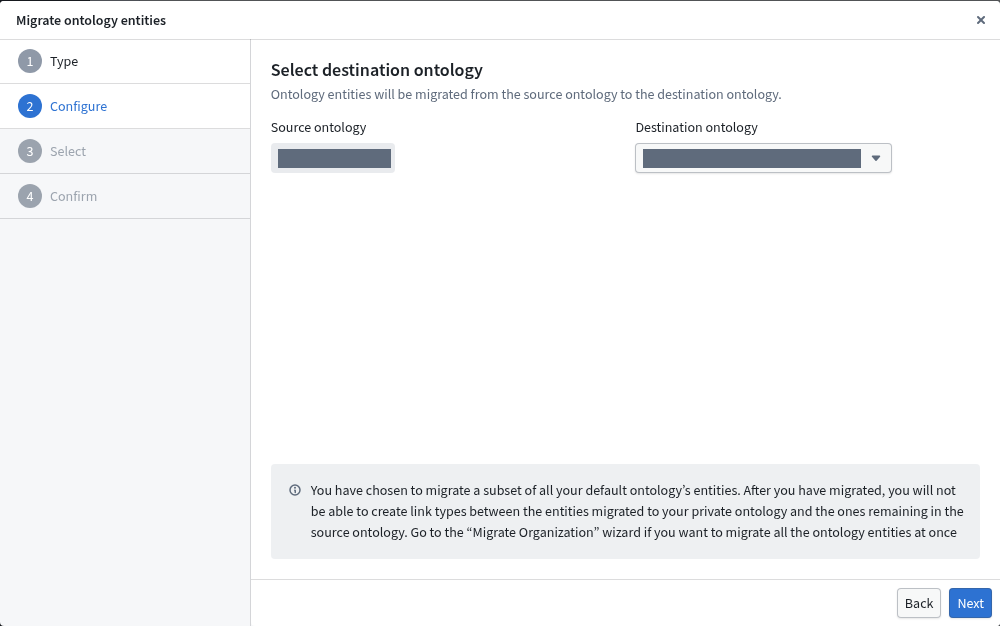
In the Configure step, choose the Destination ontology, then select Next. The Source ontology is the ontology you selected before opening the dialog.
-
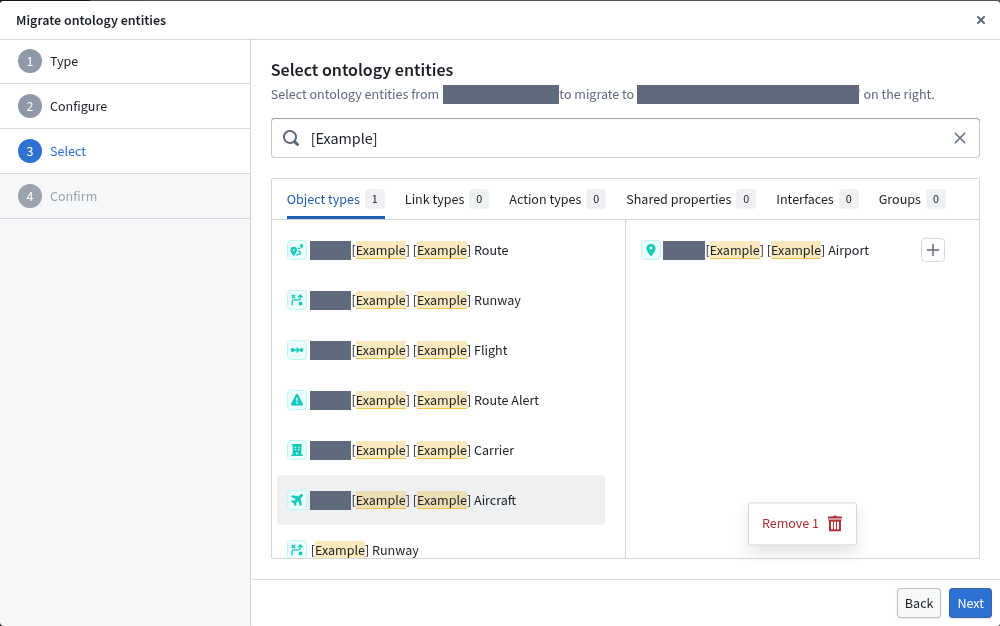
In the Select step, use the resource tabs and search field to find resources. Select resources in the left panel to add them to the migration selection in the right panel. Use Add related entities on selected object types or action types to include their related resources.
-
Review the selection across all resource tabs, then select Next.
-
If the Save location step appears for resources stored in projects, choose a destination project in the destination ontology's space, then select Next. Review the project's permissions before continuing.
-
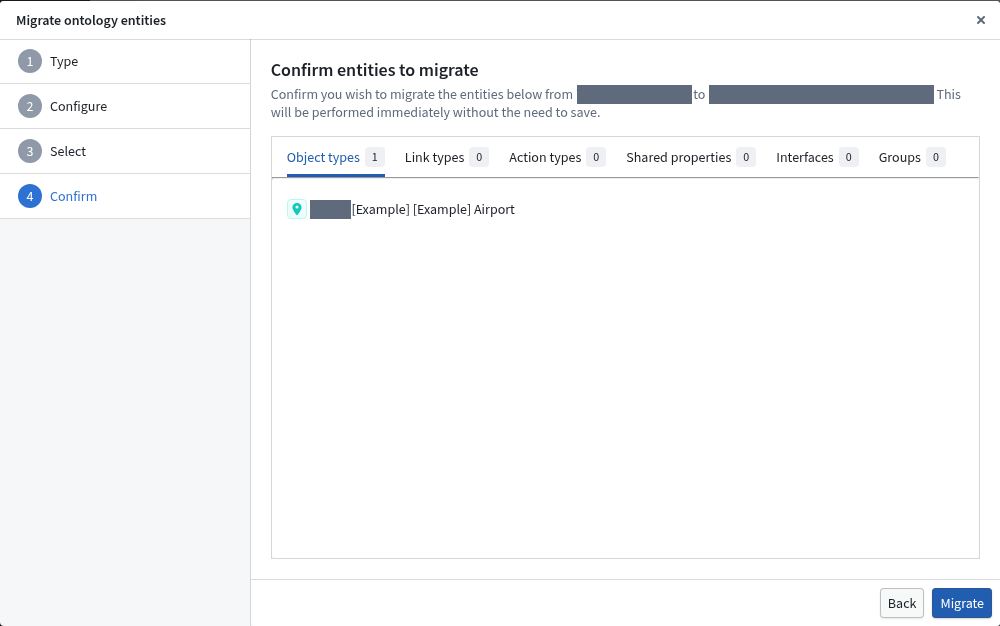
In the Confirm step, review the source ontology, destination ontology, and selected resources. Select Migrate to perform the migration immediately; no separate save is required.